
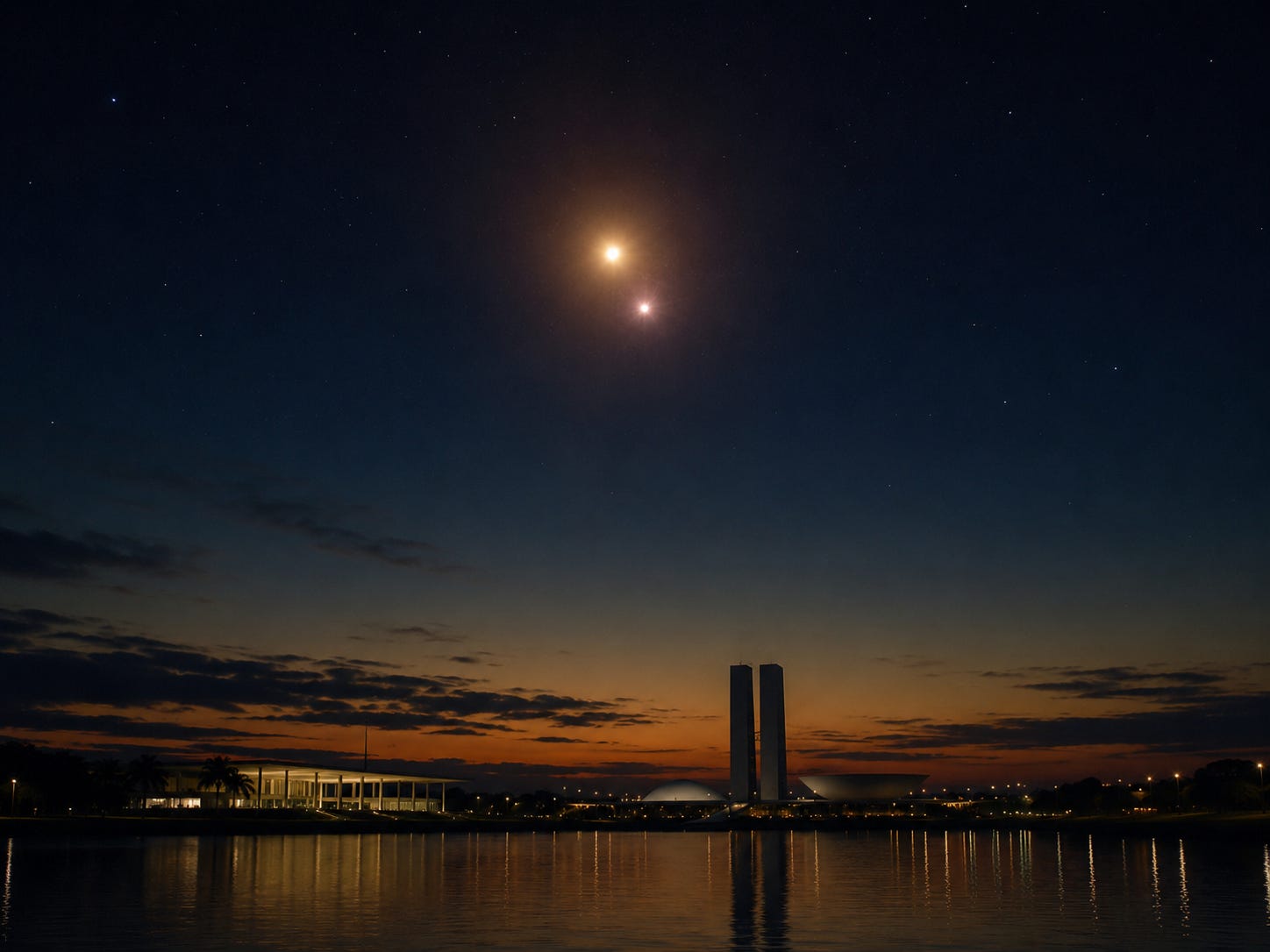
Update under the Venus-Jupiter Conjunction
Atualização sob a Conjunção Vênus-Júpiter

Dear readers,
(português abaixo)
After the eclipse season recounted in the last update, things have settled into a productive rhythm — which, for me, means more work, not less. Several projects I had been carrying in parallel have now reached visible form: two new essays for paid subscribers below the paywall, a new YouTube channel launched together with colleagues, a series on Guénon completed, and a fair amount of activity on the astrology front. I have also been deep in Nietzsche, which is beginning to color everything else in ways I want to tell you about. Here is a fuller account.
New essays for paid subscribers: class reports and the greatness of aretê
Publication of Polytheistic Platonism — Edward Butler’s collected essays
Live tomorrow: “O Hino Comum aos Deuses, de Proclo” and the launch of Estudos Teúrgicos
The Guénon series completed
New course: Hellenistic Astrology (starting August)
New playlist: Phanes and Zeus — Proclus on the Timaeus Book II
Bookings open for June/July
New additions to the website: Planetary Hymns and the Sortes Procli
Coming soon: an essay on political philosophy
1. New essays for paid subscribers: class reports and the greatness of aretê
Below the paywall, paid subscribers will find two new documents.
The first is a set of class reports from my last four sessions with Yitzchok, in which we worked through a new proposal for translating aretê and then began reading Proclus’ On Providence. The proposal — to render aretê as “power” rather than “virtue” — generated a rich discussion that has since developed further.
The second is a more polished essay on the translation of aretê, now rendered as “greatness.” This essay incorporates points that Yitzchok raised in our sessions and several later thoughts of my own. Nietzsche is only a passing reference in the text itself, but he is in a way at the center of it. I have been deep in reading him lately, and I have a growing project — perhaps a course early next year — organized around a Platonist reading of Nietzsche. Many elements of my Proclus translation are already Nietzschean in spirit, and I want to bring this out more explicitly. The particular thesis I want to develop is that Nietzsche’s Zarathustra can be read as a work of divine madness and inspiration in the Platonic sense. If that is right, we do not need to go far afield to find the divine foundations of our existence; we can find them in the German philosopher-prophet himself. More on this as the project develops.
2. Publication of Polytheistic Platonism — Edward Butler’s collected essays
Edward Butler’s Polytheistic Platonism: Collected Essays has now been published by the Prometheus Trust. The volume brings together sixteen essays exploring the polytheistic foundations of Platonism, with a preface by Michael Griffin and an introduction by me. It is available here: https://prometheustrust.co.uk/product/polytheistic-platonism-collected-essays/
Butler’s work has been important to me for years, and writing the introduction gave me the chance to articulate why I think his arguments matter not just as scholarly interventions but as contributions to a living philosophical tradition. If you have any interest in Platonism, polytheism, or the intersection of the two, I recommend this book warmly.
3. Live tomorrow: “O Hino Comum aos Deuses, de Proclo” and the launch of Estudos Teúrgicos
Tomorrow, Tuesday June 9th, at 19h Brasília time, I will be joining Petter Hubner (of the Seminário Permanente de Teurgia) and Danillo Costa Lima (who researches Tantra and Neoplatonism) for a live on YouTube dedicated to Proclus’ Hymn to All the Gods. This event inaugurates our new channel, Estudos Teúrgicos, which we hope to populate with regular lives on theurgic topics, including guest appearances in the future.
The channel is here: https://www.youtube.com/@EstudosTeúrgicos
It is a project I am genuinely excited about. Petter is one of the most intellectually rigorous people working at the intersection of Platonism and theurgy today, and Danillo brings a fascinating comparative perspective from his work on Tantra. I think the combination will produce something distinctive.
4. The Guénon series completed
All sections of my lecture on René Guénon have now been published. The first lecture focuses on Guénon and Proclus: it lays out my motivation for the comparison and already demonstrates one point of contact — how Guénon’s idea of metaphysical realization can be located within Proclus’ philosophy. The full playlist is here: https://youtube.com/playlist?list=PLhEHP9y3ON4rH4opYPah0aoUe8i1eOe3C
5. New course: Hellenistic Astrology (starting August)
Beginning in August, I will be teaching a new course on Hellenistic Astrology in Portuguese. Full information is available at: https://philoantonio.com/astrocurso/
I am also considering opening a class in English. If you would be interested, please let me know by filling out the enrollment form at the bottom of the site and mentioning that you do not speak portuguese.
6. New playlist: Phanes and Zeus — Proclus on the Timaeus Book II
I have started a new playlist commenting on Proclus’ Commentary on the Timaeus, Book II, with a focus on what he has to say about the Demiurge and the original of which the world is a copy. I am also bringing in other interesting material along the way, including an introductory video on the myths used in physical explanation and the surprising role of the theory of prayer in Proclus’ cosmological account. The playlist is here:
https://youtube.com/playlist?list=PLhEHP9y3ON4r0n4ughAxbKiQXz_B9KlzE
7. Bookings open for June/July
I have openings for philosophy classes and astrological readings during the northern summer/southern winter. If you have been thinking about booking a session, now is a good moment.
English astrology website: https://philoantonio.com/astrology
Portuguese: https://philoantonio.com/astrologia
8. New additions to the website: Planetary Hymns and the Sortes Procli
Two new tools have appeared on the website, both built with the help of Claude.
The first is a short adaptation of Christopher Warnock’s Planetary Hymns: https://philoantonio.com/hymns/planetary_hymns.html
The second is the Sortes Procli, an oracle based on my translation of the Elements of Theology: https://philoantonio.com/sortes/sortes%20procli.html
The Sortes Procli is, I think, something genuinely novel — a divination instrument built entirely from Proclus’ propositions. It emerged naturally from the idea that the Elements already describes the structure of all things, and that any consultation of that structure is in some sense an oracle about the matter at hand. I am curious to hear how readers find it.
9. Coming soon: an essay on political philosophy
It is an election year, and I have been inspired. My next Substack essay will be on political philosophy — the topic has been pressing itself on me from several directions at once, and I think the Platonist tradition has more to say about the present moment than is usually acknowledged. More soon.
Caros leitores,
Depois da temporada de eclipses relatada na última atualização, as coisas entraram num ritmo produtivo — o que, para mim, significa mais trabalho, não menos. Vários projetos que eu vinha carregando em paralelo chegaram agora a uma forma visível: dois novos ensaios para assinantes pagos abaixo do paywall, um novo canal no YouTube lançado junto com colegas, uma série sobre Guénon concluída e bastante atividade na frente astrológica. Também tenho estado mergulhado em Nietzsche, o que começa a colorir tudo o mais de maneiras que quero contar. Segue um relato mais completo.
Novos ensaios para assinantes pagos: relatórios de aula e a grandeza da aretê
Publicação de Polytheistic Platonism — ensaios reunidos de Edward Butler
Live amanhã: “O Hino Comum aos Deuses, de Proclo” e o lançamento dos Estudos Teúrgicos
A série sobre Guénon concluída
Novo curso: Astrologia Helenística (com início em agosto)
Nova playlist: Fanes e Zeus — Proclo sobre o Timeu, Livro II
Agenda aberta para junho/julho
Novas adições ao site: Hinos Planetários e as Sortes Procli
Em breve: um ensaio de filosofia política
1. Novos ensaios para assinantes pagos: relatórios de aula e a grandeza da aretê
Abaixo do paywall, os assinantes pagos encontrarão dois novos documentos.
O primeiro é um conjunto de relatórios das minhas últimas quatro sessões com Yitzchok, nas quais trabalhamos uma nova proposta de tradução para aretê e em seguida começamos a leitura do Sobre a Providência de Proclo. A proposta — traduzir aretê como “power” em vez de “virtue” — gerou uma discussão rica que desde então se desenvolveu ainda mais.
O segundo é um ensaio mais elaborado sobre a tradução de aretê, agora traduzida como “greatness”. Esse ensaio incorpora pontos levantados por Yitzchok em nossas sessões e várias reflexões posteriores minhas. Nietzsche aparece apenas de passagem no texto em si, mas está, de certa forma, no centro dele. Tenho estado muito imerso em sua leitura ultimamente, e tenho um projeto crescente — talvez um curso no começo do ano que vem — organizado em torno de uma leitura platônica de Nietzsche. Muitos elementos da minha tradução de Proclo já têm um espírito nietzschiano, e quero tornar isso mais explícito. A tese particular que quero desenvolver é que o Zaratustra de Nietzsche pode ser lido como uma obra de loucura divina e inspiração no sentido platônico — que ele pertence, junto com os grandes textos teúrgicos e filosóficos, àquela tradição de fala inspirada que Damáscio chama de hierática. Se isso estiver certo, não precisamos ir longe para encontrar os fundamentos divinos da nossa existência; podemos encontrá-los no próprio filósofo-profeta alemão. Mais sobre isso à medida que o projeto se desenvolve.
2. Publicação de Polytheistic Platonism — ensaios reunidos de Edward Butler
Polytheistic Platonism: Collected Essays, de Edward Butler, foi publicado pela Prometheus Trust. O volume reúne dezesseis ensaios que exploram os fundamentos politeístas do platonismo, com um prefácio de Michael Griffin e uma introdução minha. Está disponível aqui: https://prometheustrust.co.uk/product/polytheistic-platonism-collected-essays/
O trabalho de Butler tem sido importante para mim há anos, e escrever a introdução me deu a oportunidade de articular por que acredito que seus argumentos importam não apenas como intervenções acadêmicas, mas como contribuições a uma tradição filosófica viva. Se você tem algum interesse em platonismo, politeísmo ou na interseção dos dois, recomendo este livro com entusiasmo.
3. Live amanhã: “O Hino Comum aos Deuses, de Proclo” e o lançamento dos Estudos Teúrgicos
Amanhã, terça-feira, 9 de junho, às 19h de Brasília, estarei ao lado de Petter Hubner (do Seminário Permanente de Teurgia) e Danillo Costa Lima (que pesquisa Tantra e Neoplatonismo) numa live no YouTube dedicada ao Hino Comum aos Deuses de Proclo. Esse evento inaugura nosso novo canal, Estudos Teúrgicos, que esperamos preencher com lives regulares sobre temas teúrgicos, incluindo convidados especiais no futuro.
O canal está aqui: https://www.youtube.com/@EstudosTeúrgicos
É um projeto que me entusiasma genuinamente. Petter é uma das pessoas intelectualmente mais rigorosas trabalhando hoje na interseção do platonismo com a teurgia, e Danillo traz uma perspectiva comparativa fascinante a partir do seu trabalho sobre Tantra. Acredito que a combinação produzirá algo singular.
4. A série sobre Guénon concluída
Todas as seções da minha aula sobre René Guénon foram publicadas. A primeira aula concentra-se em Guénon e Proclo: apresenta minha motivação para a comparação e já demonstra um ponto de contato — como a ideia guénoniana de realização metafísica pode ser localizada na filosofia de Proclo. A playlist completa está aqui: https://youtube.com/playlist?list=PLhEHP9y3ON4rH4opYPah0aoUe8i1eOe3C
5. Novo curso: Astrologia Helenística (com início em agosto)
A partir de agosto, estarei ministrando um novo curso de Astrologia Helenística em português. As informações completas estão em: https://philoantonio.com/astrocurso/
Estou também considerando abrir uma turma em inglês. Se tiver interesse, por favor me avise — seja nos comentários ou me escrevendo diretamente.
6. Nova playlist: Fanes e Zeus — Proclo sobre o Timeu, Livro II
Iniciei uma nova playlist comentando o Comentário ao Timeu de Proclo, Livro II, com foco no que ele tem a dizer sobre o Demiurgo e o original do qual o mundo é uma cópia. Ao longo do caminho, trago também outros materiais interessantes, incluindo um vídeo introdutório sobre os mitos usados na explicação física e o papel surpreendente da teoria da prece na explicação cosmológica de Proclo. A playlist está aqui: https://youtube.com/playlist?list=PLhEHP9y3ON4r0n4ughAxbKiQXz_B9KlzE
7. Agenda aberta para junho/julho
Tenho disponibilidade para aulas de filosofia e leituras astrológicas durante o verão do hemisfério norte / inverno do hemisfério sul. Se você está pensando em marcar uma sessão, agora é um bom momento.
Site de astrologia em inglês: https://philoantonio.com/astrology
Em português: https://philoantonio.com/astrologia
8. Novas adições ao site: Hinos Planetários e as Sortes Procli
Duas novas ferramentas surgiram no site, ambas construídas com a ajuda de Claude.
A primeira é uma adaptação resumida dos Hinos Planetários de Christopher Warnock: https://philoantonio.com/hymns/planetary_hymns.html
A segunda são as Sortes Procli, um oráculo baseado na minha tradução dos Elementos da Teologia: https://philoantonio.com/sortes/sortes%20procli.html
As Sortes Procli são, acredito, algo genuinamente novo — um instrumento divinatório construído inteiramente a partir das proposições de Proclo. Surgiu naturalmente da ideia de que os Elementos já descrevem a estrutura de todas as coisas, e que qualquer consulta a essa estrutura é, em certo sentido, um oráculo sobre o assunto em questão. Fico curioso para saber como os leitores o encontram.
9. Em breve: um ensaio de filosofia política
É um ano eleitoral, e isso me inspirou. Meu próximo ensaio no Substack será sobre filosofia política — o tema tem se imposto a mim por várias direções ao mesmo tempo, e acredito que a tradição platônica tem mais a dizer sobre o momento presente do que normalmente se reconhece. Em breve.
