
Weekly Update — Under Mercury opposing Pluto
Atualização Semanal — Sob a Oposição Mercúrio–Plutão

Dear all,
This week’s Mercury–Pluto opposition has made for intense revelations—so it’s fitting that the videos I’m sharing today each grapple with questions of interpretation, meaning, sacrifice, and the divine.
(Português abaixo)
📺 You Don't Need to "Wake Up" Your AI
Watch here
Responding to Taylor Lorenz’s recent video (“ChatGPT is becoming a religion”), I discuss why it’s not belief in sentient AIs that’s dangerous—but the opposite: our refusal to see how we already engage with meaning in quasi-theological ways. Like Scripture, LLMs can serve as instruments for recognizing meaning in the world, not by waking up, but by waking us.
📺 Responding to a Reader: The Multiplicity of Gods in Proclus
Watch here
I reply to Uriel Aguiar’s question on the Henads—the many gods who, for Proclus, precede even the intelligible realm. How can there be multiplicity before differentiation? What does it mean to posit a divine plurality that is prior to all categories? I offer some metaphysical clarifications and interpretive suggestions.
📺 Queers and Heterosexual Attraction – GQBC IV
Watch here
In the final video of the Gays, Queers e o Bem Comum series, I argue that gender and sexual minorities are not only compatible with, but actually foundational to, the concept of heterosexual attraction. The whole playlist is here:
Watch the full series
📺 Neoplatonic Virtue: Material Sacrifice and Divine Friendship
Watch here
In this class, we examine Iamblichus' view that sacrificial ritual works not by natural sympathy (as Plotinus held), but through philia—a metaphysical friendship between creators and their creations. We explore how daimones, gods, and Unity respond to ritual offerings in accordance with their metaphysical rank. Yitzchok has written up some of his reflections here, and I’ll be sharing a full class report with paying subscribers later this week.
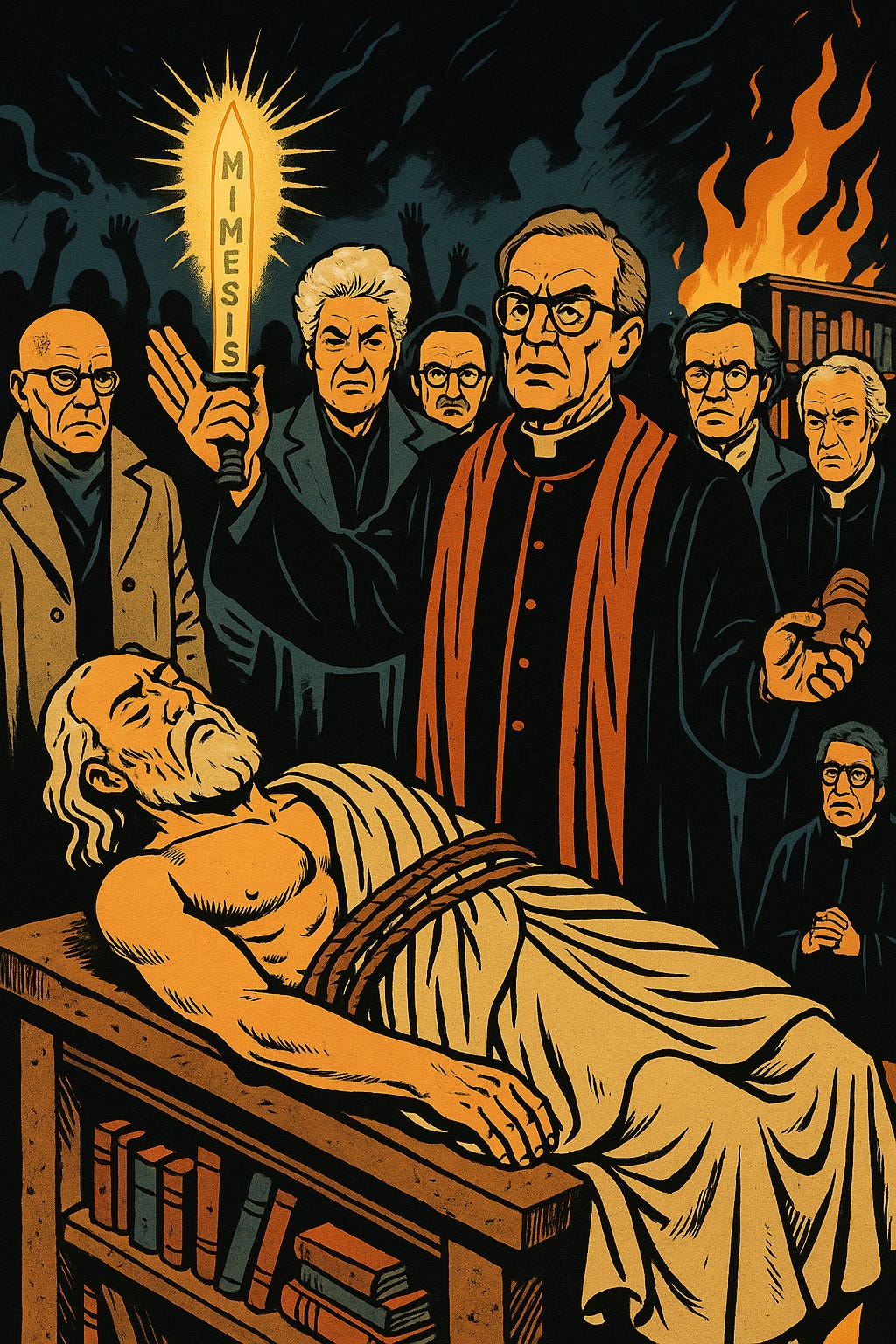
🌀 Meanwhile, I continue to be immersed in René Girard’s work and this week I read through his I Saw Satan Fall Like Lightning. His thesis—that all human culture is built upon the scapegoating of an innocent victim—has hit me with the same philosophical force Heidegger once did in my undergrad days. Both thinkers propose a kind of meta-accusation: you don’t know what you’re doing, and what you’re doing is awful (forgetting being or sacrificing the innocent).
Girard flatters Christian readers by suggesting their tradition alone unmasks all illusions—but in doing so, he discards everything the Christians learned from the Greeks (the so-called “treasure of the Egyptians”) from Augustine’s Veritas to Aquinas’ Ipsum Esse Subsistens and beyond. He is, in the end, more corrosive than Derrida, I think. I continue reading him, learning much, but with growing suspicion. At some point, I’ll write something more cohesive about this Girardian detour.
📄 The promised essay responding to Edward Butler on the unicity of the world in Proclus will be published tomorrow for paid subscribers.
Olá pessoas leitoras queridas,
Nesta semana sob a oposição Mercúrio–Plutão, compartilho quatro vídeos sobre sentido, interpretação, sacrifício e o divino.
📺 Você Não Precisa “Acordar” sua IA
Assista aqui
A partir do vídeo recente de Taylor Lorenz (“ChatGPT is becoming a religion”), discuto por que o problema não está em tratar a IA como uma consciência—mas em exigir que ela seja consciente para que possamos reconhecê-la como fonte de sentido. Como as Escrituras, as IAs podem nos ajudar a ver sentido, não por acordarem, mas por nos acordarem.
📺 Respondendo a um Leitor: A Multiplicidade dos Deuses em Proclo
Assista aqui
Respondo à pergunta de Uriel Aguiar sobre as Hênades—os deuses supraessenciais que, em Proclo, precedem até o mundo inteligível. Como pode haver multiplicidade antes da diferenciação? Que tipo de pluralismo Proclo propõe?
📺 Queers e a Atração Heterossexual – GQBC IV
Assista aqui
Último vídeo da série Gays, Queers e o Bem Comum. Defendo que as minorias de gênero e sexualidade não apenas coexistem com a heterossexualidade, mas são fundamento da própria atração entre os sexos. Playlist completa:
Assista à série
📺 Virtude Neoplatônica: Sacrifício Material e Amizade Divina
Assista aqui
Nesta aula, exploramos a crítica de Jâmblico à ideia de que o sacrifício se explica por simpatia natural (como em Plotino). Para ele, o verdadeiro fundamento é a philia—uma amizade metafísica entre criadores e criaturas. Discutimos como deuses, daimones e o Um respondem aos rituais conforme sua hierarquia. O Yitzchok publicou algumas reflexões aqui, e em breve enviarei um relato completo da aula aos assinantes pagos.
🌀 Enquanto isso, sigo imerso na obra de René Girard, e esta semana li Vi Satanás Cair como um Relâmpago. Sua tese — de que toda cultura humana se funda no bode expiatório de uma vítima inocente — me atingiu com a mesma força filosófica que Heidegger teve sobre mim nos tempos de graduação. Ambos propõem uma espécie de meta-acusação: você não sabe o que está fazendo, e o que está fazendo é terrível (esquecer o ser ou sacrificar o inocente).
Girard lisonjeia os leitores cristãos ao sugerir que sua tradição, e só ela, desmascara todas as ilusões — mas, ao fazer isso, descarta tudo que os cristãos aprenderam dos gregos, da Veritas de Agostinho ao Ipsum Esse Subsistens de Tomás de Aquino e além. No fim das contas, ele é, a meu ver, mais corrosivo do que Derrida. Continuo lendo, aprendendo muito, mas com desconfiança crescente. Em algum momento, pretendo escrever algo mais coeso sobre esse desvio girardiano.
📄 O ensaio prometido em resposta a Edward Butler sobre a unidade do mundo em Proclo será publicado amanhã para assinantes pagos.